
Understanding R744 CO₂ Pressure and Temperature
Carbon dioxide, known as R744 when used as a refrigerant, is increasingly used in commercial and industrial refrigeration applications. Unlike many conventional refrigerants, R744 operates at comparatively high pressures and has a relatively low critical temperature, making an understanding of its pressure-temperature relationship particularly important.
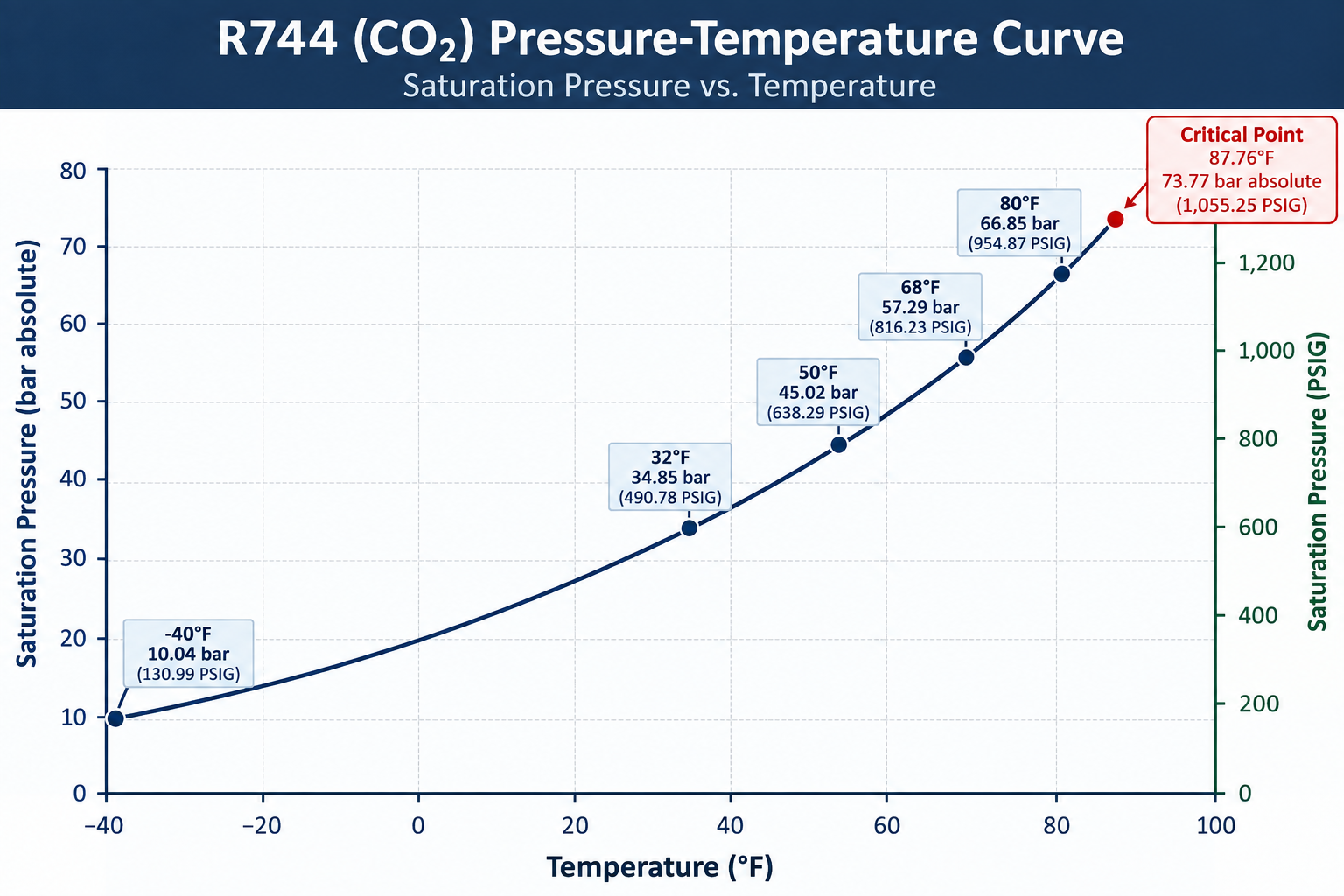
The R744 pressure-temperature chart below provides the saturation pressure of CO₂ at different temperatures. It can be used as a quick reference for technicians, engineers, and other refrigeration professionals working with CO₂ systems.
Note: PSIG represents gauge pressure, while PSIA and bar absolute represent absolute pressure. Always verify the pressure reference and units being used when comparing pressure values from charts, instruments and technical documentation.
Need to convert between pressure units? Use the NDL Industries Pressure Conversion Calculator to convert between BAR, PSI, and MPa.
How to Read an R744 Pressure-Temperature Chart
An R744 pressure-temperature chart allows you to reference the saturation pressure of CO₂ at a specific temperature or determine the corresponding saturation temperature for a known pressure.
As the saturation temperature of R744 increases, so does its saturation pressure. This increase becomes particularly significant as CO₂ approaches its critical point.
When using the chart, it is important to know whether the pressure is expressed as gauge or absolute pressure.
PSIG, or pounds per square inch gauge, measures pressure relative to atmospheric pressure.
PSIA, or pounds per square inch absolute, measures pressure relative to a perfect vacuum.
Similarly, pressure expressed in bar may be provided as either barg, gauge pressure, or bara, meaning absolute pressure.
Because of this distinction, two pressure values can appear different even when they represent the same physical condition. Always confirm the pressure reference before comparing values.
What is R744 Refrigerant?
R744 is the refrigerant designation for carbon dioxide, or CO₂. It is a naturally occurring substance that can be used as a refrigerant in commercial, industrial, and other refrigeration applications.
R744 has a Global Warming Potential of 1 according to the U.S. Environmental Protection Agency. It is also classified as an A1 refrigerant under ASHRAE’s refrigerant safety classification system.
| Property | R744 |
|---|---|
| Refrigerant | Carbon Dioxide |
| Chemical Formula | CO₂ |
| Refrigerant Number | R744 |
| GWP | 1 |
| ODP | 0 |
| ASHRAE Safety Classification | A1 |
| Critical Temperature | 87.76°F / 30.98°C |
| Critical Pressure | 1,070 PSIA / 73.77 BAR absolute |
NIST’s 2026 equation of state for carbon dioxide identifies its critical temperature as 304.1282 K and its critical pressure as 7.37703 MPa.
For R744 and other commonly used refrigerants, visit our Refrigerant Table to compare GWP, ODP, and ASHRAE safety classifications.
For additional information about refrigerant designations, see ASHRAE’s Refrigerant Designations resource.
Why Is CO₂ Called R744?
The name R744 comes from the refrigerant numbering system established by ASHRAE. While many synthetic refrigerants are assigned numbers based on their chemical composition, inorganic refrigerants such as carbon dioxide, ammonia, and water are designated within the 700 series.
For these refrigerants, the designation is generally determined by adding the refrigerant’s molecular weight to 700.
Carbon dioxide (CO₂) has a molecular weight of approximately 44 g/mol:
Carbon: 12.01
Oxygen: 16.00 × 2 = 32.00
Total molecular weight: approximately 44
Adding 44 to 700 gives:
700 + 44 = 744
This is why carbon dioxide is designated R744 when used as a refrigerant.
Other examples of refrigerants in the 700 series include:
| Refrigerant | Designation |
|---|---|
| Ammonia | R717 |
| Water | R718 |
| Air | R729 |
| Carbon Dioxide | R744 |
The “R” simply identifies the substance as a refrigerant, while “744” identifies carbon dioxide within the refrigerant designation system.
What is the Critical Point of R744?
The critical point is one of the most important concepts to understand when working with R744.
A refrigerant’s critical point is the temperature and pressure above which there is no distinct boundary between its liquid and vapor phases.
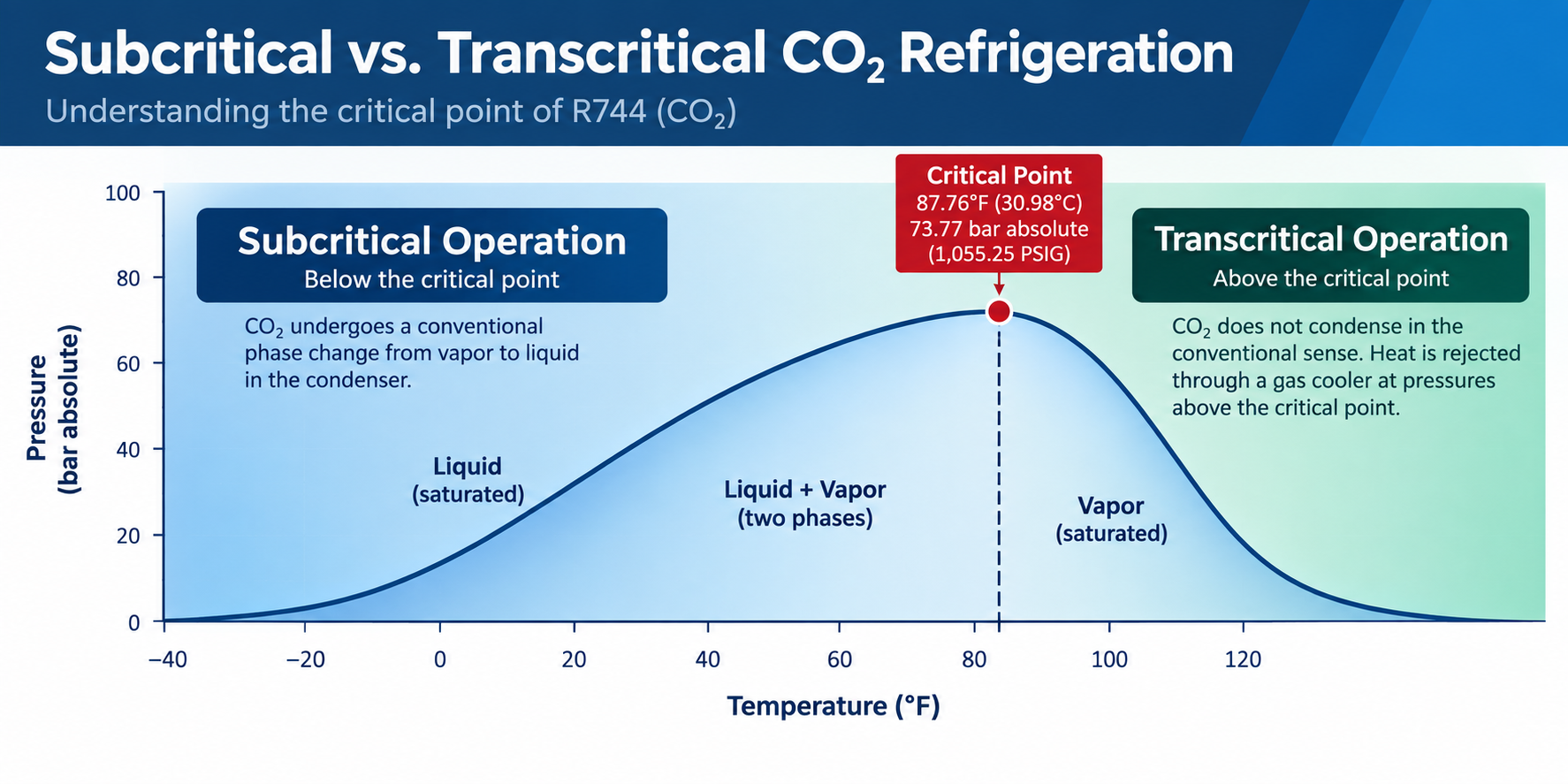
For CO₂, the critical temperature is approximately 87.76°F (30.98°C), and the critical pressure is approximately 1,070 psia (73.77 bar absolute).
This relatively low critical temperature is also the reason a conventional R744 pressure-temperature chart stops around 87.76°F.
Above the critical temperature, there is no conventional liquid-vapor saturation relationship. Therefore, there is no corresponding saturation pressure to continue plotting on a traditional P T chart.
This is an important distinction between R744 and many conventional refrigerants.
Subcritical vs. Transcritical CO₂ Refrigeration
R744 refrigeration systems can operate under both subcritical and transcritical conditions.
In subcritical operation, the heat rejection process occurs below the critical point of CO₂. Under these conditions, the refrigerant can undergo a conventional phase change from vapor to liquid.
In transcritical operation, part of the refrigeration cycle operates above the critical point. Above this point, CO₂ does not condense in the conventional sense. Instead, heat is rejected from the high-pressure refrigerant through a gas cooler. After the high-pressure expansion valve, the refrigerant enters the two-phase region, resulting in a mixture of liquid and vapor.
For additional information on transcritical CO₂ refrigeration, see the U.S. EPA’s overview of Advanced Refrigeration Technologies.
Why Does CO₂ Refrigeration Operate at Higher Pressures?
R744 has thermodynamic properties that result in substantially higher operating pressures than many conventional refrigeration systems.
Its saturation pressure rises rapidly as temperature approaches the critical point. As a result, pressure is a particularly important consideration when designing, installing, and servicing CO₂ refrigeration systems.
ASHRAE’s comparative refrigerant data demonstrates this difference. Under the conditions used in its comparison, R744 operates at substantially higher evaporator and condenser pressures than refrigerants such as R22, R134a, and R410A.
However, this does not mean that every component or section of a CO₂ refrigeration system operates at the same pressure.
Different portions of a system can experience different operating and design pressures depending on system architecture, operating conditions, and application. Components should therefore be selected based on the pressure and temperature requirements of their intended location within the system.
Selecting Components for CO₂ Refrigeration Systems
The higher pressures associated with R744 make component selection an important part of CO₂ refrigeration system design.
Valves, fittings, tubing, and other components should be selected according to the pressure, temperature, and application requirements of the specific portion of the system in which they will be installed.
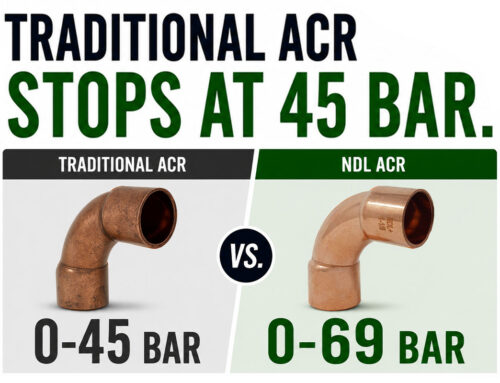
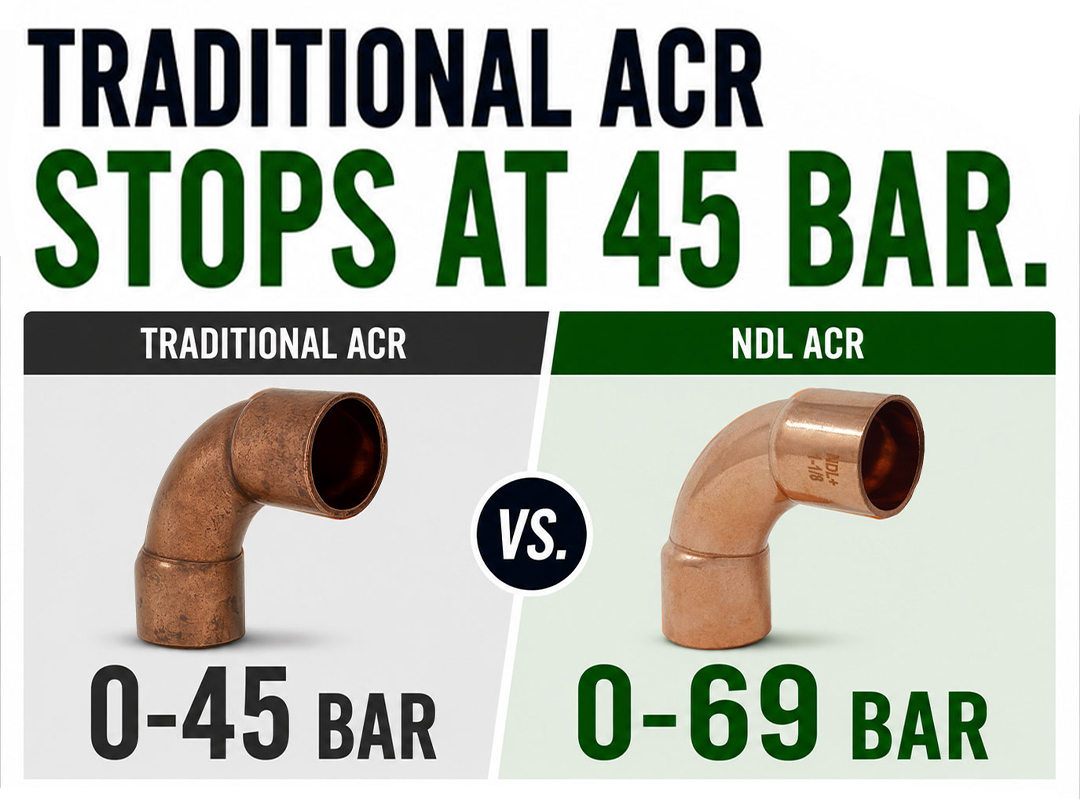
NDL Industries offers CO₂ Copper Fittings manufactured from C19400 CuFe2P copper iron alloy and rated for a maximum operating pressure of 130 bar.
When selecting components for an R744 refrigeration system, always verify factors including maximum operating pressure, temperature range, material compatibility, certifications, and intended application.
R744 Pressure Temperature Frequently Asked Questions
What is R744?
R744 is the refrigerant designation for carbon dioxide, or CO₂. It is used as a refrigerant in applications including commercial and industrial refrigeration.
Is R744 the same as CO₂?
Yes. R744 is the refrigerant designation for carbon dioxide when it is used as a refrigerant.
What is the GWP of R744?
R744 has a Global Warming Potential of 1. The U.S. Environmental Protection Agency lists R744 as carbon dioxide with a GWP of 1.
View the EPA GWP Reference Table
What is the ASHRAE safety classifications of R744?
R744 is classified as an A1 refrigerant under the ASHRAE refrigerant safety classification system.
What is the critical temperature of R744?
The critical temperature of R744 is approximately 87.76°F (30.98°C).
What is the critical pressure of R744?
The critical pressure of R744 is approximately 1,070 psia (73.77 bar absolute).
Why does an R744 pressure-temperature chart stop at 87.76°F?
A conventional P T chart represents the saturation relationship between the liquid and vapor phases of a refrigerant. Once CO₂ reaches its critical temperature, there is no distinct liquid-vapor phase boundary. Therefore, the conventional saturation pressure-temperature relationship no longer applies above approximately 87.76°F.
What is the difference between PSIG and PSIA?
PSIG measures pressure relative to atmospheric pressure, while PSIA measures pressure relative to a perfect vacuum. This difference should always be considered when comparing pressure values from different R744 charts or technical resources.
Is R744 a high-pressure refrigerant?
R744 operates at substantially higher pressures than many conventional refrigeration refrigerants. The exact operating pressure varies based on system design, location within the system, temperature, and operating conditions.
What is transcritical CO₂ refrigeration?
Transcritical operation occurs when part of the CO₂ refrigeration cycle operates above R744’s critical point. Under these conditions, heat rejection occurs without the conventional condensation process used below the critical point.
Understanding R744 Pressure in CO₂ Refrigeration
The pressure-temperature relationship of R744 is an important reference for anyone working with CO₂ refrigeration systems.
As R744’s saturation temperature increases, its saturation pressure rises significantly until the refrigerant reaches its critical point at approximately 87.76°F and 73.77 bar absolute. Above this point, a conventional saturation P T relationship no longer exists.
Understanding this relationship, along with the difference between gauge and absolute pressure, can help technicians and engineers interpret system conditions and select components appropriate for different areas of a CO₂ refrigeration system.
Use the NDL Industries Refrigerant Table to compare R744 with other refrigerants or use our Pressure Conversion Calculator to quickly convert pressure values between BAR, PSI, and MPa.