Understanding Pressure Zones in CO₂ Refrigeration: Where High-Pressure Fittings Are—and Aren’t—Needed
As the refrigeration industry continues its transition toward natural refrigerants, carbon dioxide (CO₂/R744) has become one of the leading choices for commercial applications such as supermarkets, cold storage facilities, food processing plants, and distribution centers. Its excellent thermodynamic properties and low environmental impact make it an attractive long-term refrigerant, but it also introduces one of the most misunderstood aspects of system design: operating pressure.
One of the most common misconceptions surrounding transcritical CO₂ refrigeration systems is that every component throughout the system must be capable of handling the maximum pressure generated by the refrigerant. While CO₂ systems do operate at significantly higher pressures than traditional HFC or HCFC refrigeration systems, those pressures are not present everywhere at the same time.
Understanding where pressure changes throughout a CO₂ refrigeration system are essential for selecting the appropriate valves, fittings, and piping components. Choosing products based on the actual operating conditions of each section of the system can help engineers, contractors, and distributors optimize performance, simplify inventory, and avoid unnecessary costs without compromising safety or reliability.
Understanding Pressure Zones in a Modern CO₂ Refrigeration System
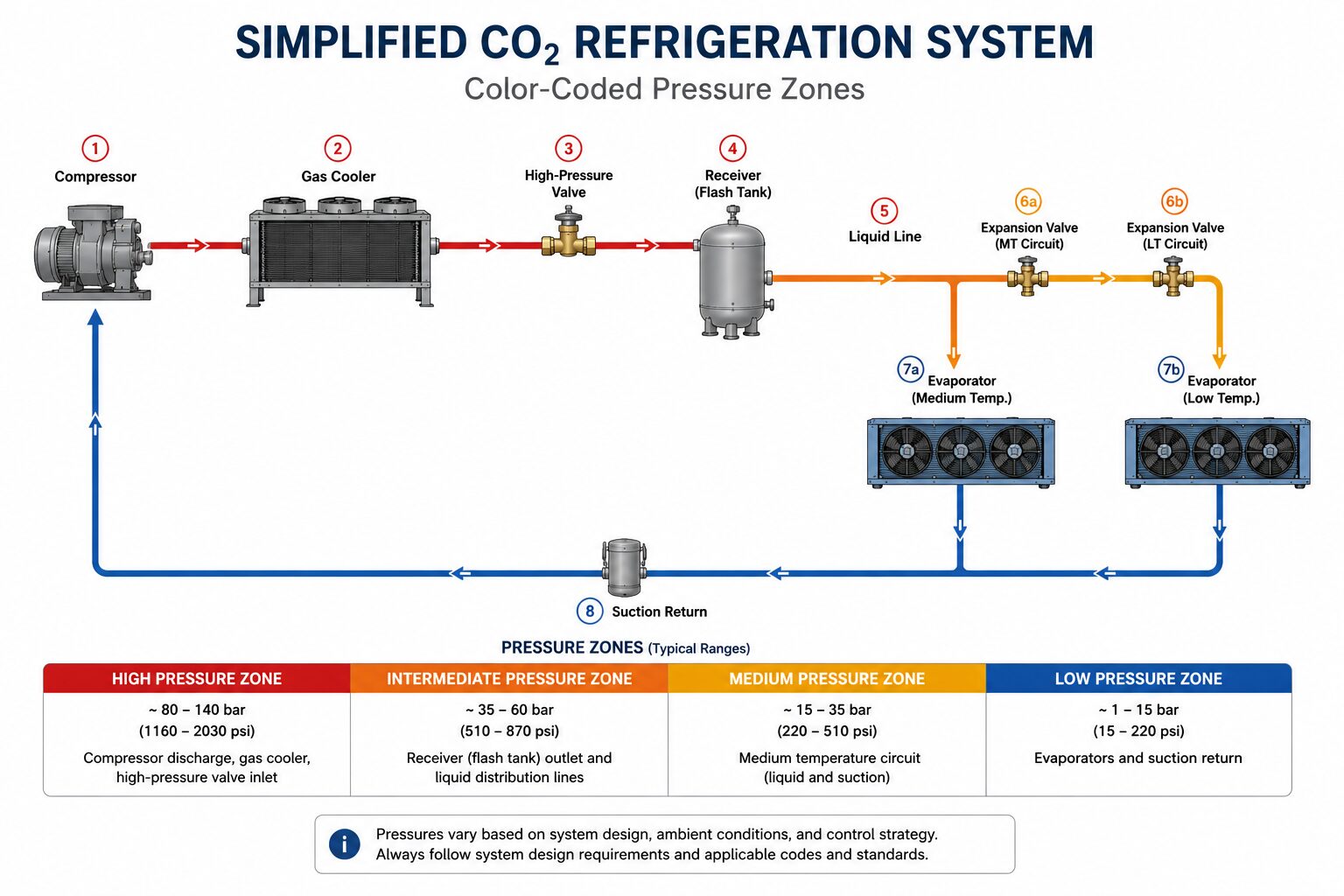
Unlike conventional refrigeration systems that operate within a relatively narrow pressure range, transcritical CO₂ systems contain multiple pressure zones. As the refrigerant travels through the system, its pressure changes depending on whether it is being compressed, cooled, expanded, or evaporated.
Generally, a transcritical CO₂ refrigeration system can be divided into three primary pressure regions:
Each of these areas places different demands on system components.
The high-pressure side begins at the compressor discharge and extends through the gas cooler and receiver. Depending on ambient conditions and system operation, pressures in this section can exceed 120 bar.
After expansion, the refrigerant enters lower-pressure portions of the system where pressures decrease substantially. Medium-pressure liquid lines and evaporator circuits typically operate well below the maximum pressure experienced on the discharge side, while suction lines often operate at even lower pressures.
This variation is precisely why engineers evaluate each section independently when selecting system components.
While CO₂ systems operate at significantly higher pressures than many traditional refrigerants, refrigerant safety classifications—including CO₂ (R744)—are defined under ASHRAE Standard 34, which classifies refrigerants according to toxicity and flammability. Although Standard 34 does not establish pressure ratings for piping components, it provides an important foundation for refrigerant identification and safety.
Why Not Every Section Requires High-Pressure Fittings
Because CO₂ systems can reach very high pressures, it’s understandable why many assume every fitting should carry the highest available pressure rating. However, engineering best practice is to select components based on the design pressure and operating conditions of each section of the system.
Installing high-pressure components where they are not required may increase project costs without providing meaningful operational advantages.
For example, the gas cooler outlet and compressor discharge experience much higher pressures than suction lines or certain medium-pressure liquid lines. Selecting the appropriate fitting for each pressure zone allows engineers to maintain safety while optimizing material selection throughout the installation.
This approach also provides benefits such as:
Ultimately, the goal is not to minimize pressure ratings but to match the pressure capability of each component to its intended application.
Selecting components based on their intended operating conditions is a common engineering practice. Organizations such as the International Institute of All-Natural Refrigeration (IIAR) publish technical guidance and industry best practices that support safe and effective refrigeration system design.
| System Selection | Typical Operating Pressure | High-Pressure Fittings Required? |
|---|---|---|
| Compressor Discharge | High | Yes |
| Gas Cooler | High | Yes |
| Receiver | High | Yes |
| Flash Gas Line | Medium | Depends on design |
| Liquid Line | Medium | Often not required |
| Suction Line | Lower | Often not required |
Where ACR Copper Fittings Can Be Used
Air Conditioning and Refrigeration (ACR) copper fittings have long been used throughout refrigeration systems because of their reliability, ease of installation, and compatibility with copper piping.
As CO₂ refrigeration has become more common, many engineers have questioned whether ACR fittings still have a place within these systems. The answer depends on the pressure rating of the fitting and the operating pressure of the section in which it will be installed.
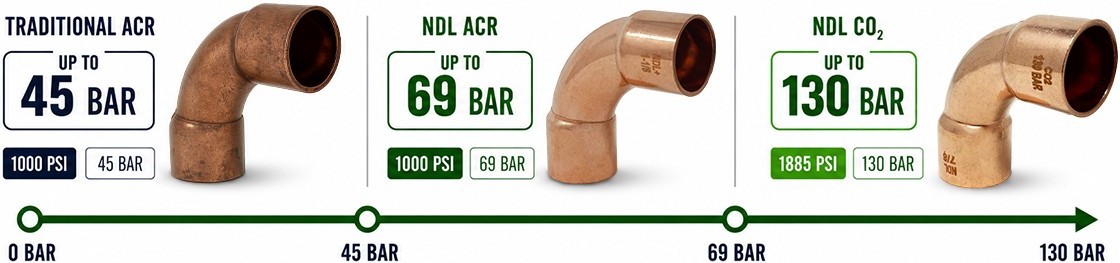
Traditional ACR copper fittings are commonly rated for applications up to approximately 45 bar (653 PSI). While suitable for many conventional refrigeration systems, that pressure rating may limit their use in certain CO₂ applications.
Modern ACR copper fittings with higher pressure capabilities can extend their use into additional portions of today’s multi-pressure CO₂ systems where operating pressures remain within the fitting’s approved rating.
Rather than viewing every CO₂ installation as requiring only specialized high-pressure fittings, engineers can evaluate each pressure zone individually and determine where appropriately rated ACR fittings are suitable.
This approach supports both engineering efficiency and cost optimization while maintaining compliance with applicable codes and manufacturer specifications.
Engineering Consideration: The suitability of any fitting depends on the specific application and operating conditions. Final component selection should always be based on system design pressure, pressure relief strategy, applicable codes and standards, manufacturer specifications, and the requirements of the engineer of record.
Properly rated ACR copper fittings can be used in portions of a CO₂ refrigeration system where operating pressures remain within the fitting’s approved rating.
Where High-Pressure CO₂ Copper Fittings Are Required
Although many areas of a CO₂ system operate below maximum pressure, certain sections require components specifically designed for high-pressure service.
These typically include:
CO₂ copper fittings designed specifically for these applications provide the pressure capability necessary for these demanding operating conditions.
Selecting appropriately rated fittings for these areas helps ensure long-term reliability while supporting system safety throughout varying ambient conditions.
High-pressure components should always be selected according to applicable engineering standards, equipment manufacturer recommendations, and local regulatory requirements.
For high-pressure areas such as the compressor discharge, gas cooler, and receiver piping, CO₂ copper fittings are designed for the elevated pressures found in transcritical CO₂ systems.
The Cost of Over-Specifying Every Component
Over-specification is a common challenge in commercial refrigeration projects.
When every fitting is selected based solely on the maximum system pressure rather than the pressure within its specific location, project costs can increase unnecessarily.
Potential impacts include:
By selecting components appropriate for each pressure zone, contractors and distributors can simplify purchasing while maintaining engineering requirements.
This approach becomes increasingly valuable on larger supermarket installations where hundreds of fittings may be required throughout multiple refrigeration circuits.
| Specification Strategy | Potential Outcome |
|---|---|
| High-pressure fittings throughout | Higher material cost and inventory requirements |
| Pressure-zone-based selection | Optimized material selection and project efficiency |
Choose the Right Fittings for Each Pressure Zone
Every refrigeration system should be evaluated based on its individual design requirements. Engineers should consider operating pressure, safety factors, applicable standards, and manufacturer ratings before selecting components.
As a general comparison:
| Fitting Type | Typical Pressure Capability | Typical Applications |
|---|---|---|
| Traditional ACR Copper Fittings | Up to approximately 45 Bar (653 PSI) | Conventional refrigeration systems |
| Higher-Pressure ACR Copper Fittings | Up to approximately 69 bar (1000 PSI) | Additional medium-pressure CO₂ applications where appropriate |
| CO₂ Copper Fittings | Up to approximately 130 bar (1885 PSI) | High-pressure CO₂ refrigeration systems |
Using the appropriate fitting for each portion of the refrigeration system allows designers to balance safety, performance, and project cost without unnecessarily specifying higher-pressure components where they are not required.
What About Copper Press Fittings?
While copper press fittings have become increasingly popular across hydronic and plumbing applications because of their installation speed and reduced reliance on open flames, they are generally intended for different operating conditions than refrigeration-specific copper fittings.
Depending on the application, press technology may offer advantages for water-based mechanical systems, while brazed ACR and specialized CO₂ fittings continue to serve refrigeration installations designed around refrigerant piping.
Understanding the intended application of each product family helps engineers and contractors select components appropriate for the media, operating pressure, and installation requirements.
While refrigeration systems require components rated for refrigerant applications, copper press fittings are commonly used in hydronic and mechanical piping systems where press technology can help streamline installation.
Disclaimer: This article is intended for general educational purposes only and should not be used as a substitute for engineering design or code compliance. Component selection should always be verified against applicable codes, system requirements, manufacturer documentation, and the project engineer’s specifications.
Making the Right Choice for Every Pressure Zone
As CO₂ refrigeration continues to gain momentum across commercial and industrial applications, understanding pressure zones has become increasingly important for engineers, contractors, distributors, and system designers.
While transcritical CO₂ systems operate at higher pressures than traditional refrigeration systems, those pressures are not uniform throughout the installation. Different sections of the system experience different operating conditions, allowing components to be selected based on their intended application rather than the system’s maximum pressure alone.
By understanding where high-pressure fittings are required—and where appropriately rated ACR copper fittings may be suitable, project teams can make informed specification decisions that balance safety, performance, compliance, and cost.
Whether designing a new supermarket installation or expanding an existing refrigeration system, evaluating each pressure zone individually helps ensure every component is selected for the job it is intended to perform.
As CO₂ adoption continues to expand across supermarkets, cold storage, and industrial refrigeration, organizations such as ATMOsphere continue to provide valuable industry research, market insights, and educational resources that help engineers and contractors stay informed about natural refrigerant technologies.
Frequently Asked Questions
Can ACR copper fittings be used in CO₂ refrigeration systems?
They can be used in certain portions of CO₂ refrigeration systems when the fitting’s pressure rating is appropriate for the operating conditions and complies with applicable engineering standards and manufacturer recommendations.
Do all CO₂ refrigeration lines require high-pressure fittings?
No. Modern CO₂ refrigeration systems contain multiple pressure zones. High-pressure fittings are required where operating pressures demand them, while other portions of the system may use appropriately rated alternatives.
Why are pressure zones important?
Pressure zones help engineers select components based on actual operating conditions instead of assuming every component must withstand the system’s maximum pressure.
What’s the difference between traditional ACR fittings and CO₂ fittings?
Traditional ACR fittings are typically intended for conventional refrigeration operating pressures, while dedicated CO₂ fittings are designed for substantially higher-pressure applications commonly found in transcritical CO₂ systems.
How does selecting fittings by pressure zone benefit a project?
Selecting components according to the operating pressure of each section can improve procurement efficiency, reduce unnecessary material costs, simplify inventory management, and support reliable long-term system performance.