ACR Copper Tubing Sizes: A Complete Guide for HVAC & Refrigeration
Copper tubing is widely used in air conditioning, refrigeration, and HVAC systems due to its thermal conductivity, durability, and ability to form reliable connections. However, selecting the correct copper tube size requires understanding outside diameter (OD), inside diameter (ID), wall thickness, and the differences between refrigeration and plumbing sizing conventions.
The ACR copper tube size chart below provides a quick reference for common refrigeration tubing dimensions, including fractional inch sizes and their metric equivalents.
Whether you’re installing refrigerant lines, selecting copper fittings, or comparing tubing dimensions, this guide will help you understand ACR copper tube sizing and important considerations for selecting compatible components.
ACR Copper Tube Size Chart: Inches to Millimeters
Air Conditioning and Refrigeration (ACR) copper tubing is generally identified by its outside diameter rather than the nominal sizing convention commonly used for plumbing copper tubing.
The following chart lists common ACR copper tubing sizes and their outside diameter conversions from inches to millimeters.
ACR Copper Tube Size Chart
Find common ACR tubing outside diameters and their metric equivalents.
| Tube Size (inches OD) | Outside Diameter (mm) |
|---|---|
| 1/8″ | 3.175 |
| 3/16″ | 4.763 |
| 1/4″ | 6.350 |
| 5/16″ | 7.938 |
| 3/8″ | 9.525 |
| 1/2″ | 12.700 |
| 5/8″ | 15.875 |
| 3/4″ | 19.050 |
| 7/8″ | 22.225 |
| 1-1/8″ | 28.575 |
| 1-3/8″ | 34.925 |
| 1-5/8″ | 41.275 |
| 2-1/8″ | 53.975 |
| 2-5/8″ | 66.675 |
| 3-1/8″ | 79.375 |
| 3-5/8″ | 92.075 |
| 4-1/8″ | 104.775 |
Note: Values show are nominal outside diameter conversions from inches to millimeters, rounded to three decimal places. Actual dimensions are subject to manufacturing tolerances. Verify product specifications before selecting tubing or fittings.
For additional information on copper tubing dimensions and physical characteristics, consult the Copper Development Association’s Copper Tube Handbook. Table 14.2e provides detailed ACR copper tubing dimensions, including outside diameter, inside diameter, and wall thickness.
What Is ACR Copper Tubing?
ACR stands for Air Conditioning and Refrigeration. ACR copper tubing is designed for use in refrigerant piping systems, including residential air conditioning, commercial refrigeration, heat pumps, and other HVAC applications.
Copper tubing used for refrigeration must meet requirements related to cleanliness, dimensional consistency, and compatibility with the intended operating conditions.
In North America, ASTM B280 is a commonly referenced standard for seamless copper tubing intended for field air conditioning and refrigeration applications.
Unlike general-purpose plumbing tubing, ACR tubing is typically prepared to minimize contamination inside the tube. Depending on its form, it may be dehydrated, cleaned, and sealed at the ends to protect its internal surfaces before installation.
These characteristics help reduce the introduction of moisture, particles, and other contaminants into refrigerant systems.
For more information about ACR copper tubing requirements, refer to ASTM B280: Standard Specification for Seamless Copper Tube for Air Conditioning and Refrigeration Field Service.
Understanding Copper Tube Outside Diameter (OD) vs. Inside Diameter (ID)
One of the most important distinctions when selecting refrigeration copper tubing is the difference between outside diameter and inside diameter.
Outside Diameter (OD)
The outside diameter is the distance across the exterior of a copper tube. This measurement is commonly used to identify ACR tubing sizes and determine compatibility with refrigeration fittings.
For example, a 7/8″ ACR copper tube has a nominal outside diameter of 7/8″, equivalent to 22.225 mm.
Inside Diameter (ID)
The inside diameter represents the internal opening through which refrigerant flows.
Unlike the outside diameter, the inside diameter changes depending on the tube’s wall thickness.
A thicker wall reduces the available internal diameter even when the outside diameter remains the same.

How to Calculate Copper tube Inside Diameter
The approximate inside diameter of a copper tube can be calculated using the following formula:
Inside Diameter = Outside Diameter − (2 × Wall Thickness)
For example, consider a copper tube with:
0.875 − (2 × 0.045) = 0.785″
The resulting nominal inside diameter is approximately 0.785″, or 19.939 mm.
This calculation illustrates why tubing with identical outside diameters can have different internal dimensions depending on wall thickness.
Note: This is an illustrative dimensional calculation. Always confirm actual tube specifications and manufacturing tolerances.
ACR Copper Tubing Wall Thickness
Copper tubing wall thickness plays an important role in determining its mechanical strength, internal flow area, and suitability for the intended application.
While outside diameter identifies the tube’s general size, wall thickness is a separate specification that must be verified when selecting tubing for a refrigeration system.
Several factors influence the required wall thickness, including:
ACR copper tubing is manufactured in different forms and wall thicknesses. Straight lengths of drawn tubing and annealed coils may have different dimensional specifications, even when they share the same outside diameter.
Consequently, there is no single wall thickness that can be assumed for every ACR tube size.
When evaluating copper tube wall thickness, refer to the applicable tubing standard, published technical dimensional tables, and the requirements of the refrigeration system.
Does Thicker Copper Tubing Have a Higher Pressure Rating?
For otherwise identical tubing of the same material, temper, and operating conditions, increasing wall thickness can increase its pressure capacity.
However, pressure ratings cannot be determined by wall thickness alone.
Allowable working pressure depends on several factors, including material properties, manufacturing tolerances, temperature, applicable design standards, and the safety factors used in the calculation.
The system’s allowable pressure may also be limited by components such as fittings, valves, joints, and connected equipment.
Always verify the pressure requirements and ratings of the complete refrigeration assembly rather than relying solely on tubing dimensions.
For help comparing different pressure units, use our Pressure Conversion Calculator for BAR, PSI, and MPa.
ACR Copper Tubing vs. Plumbing Copper Tubing
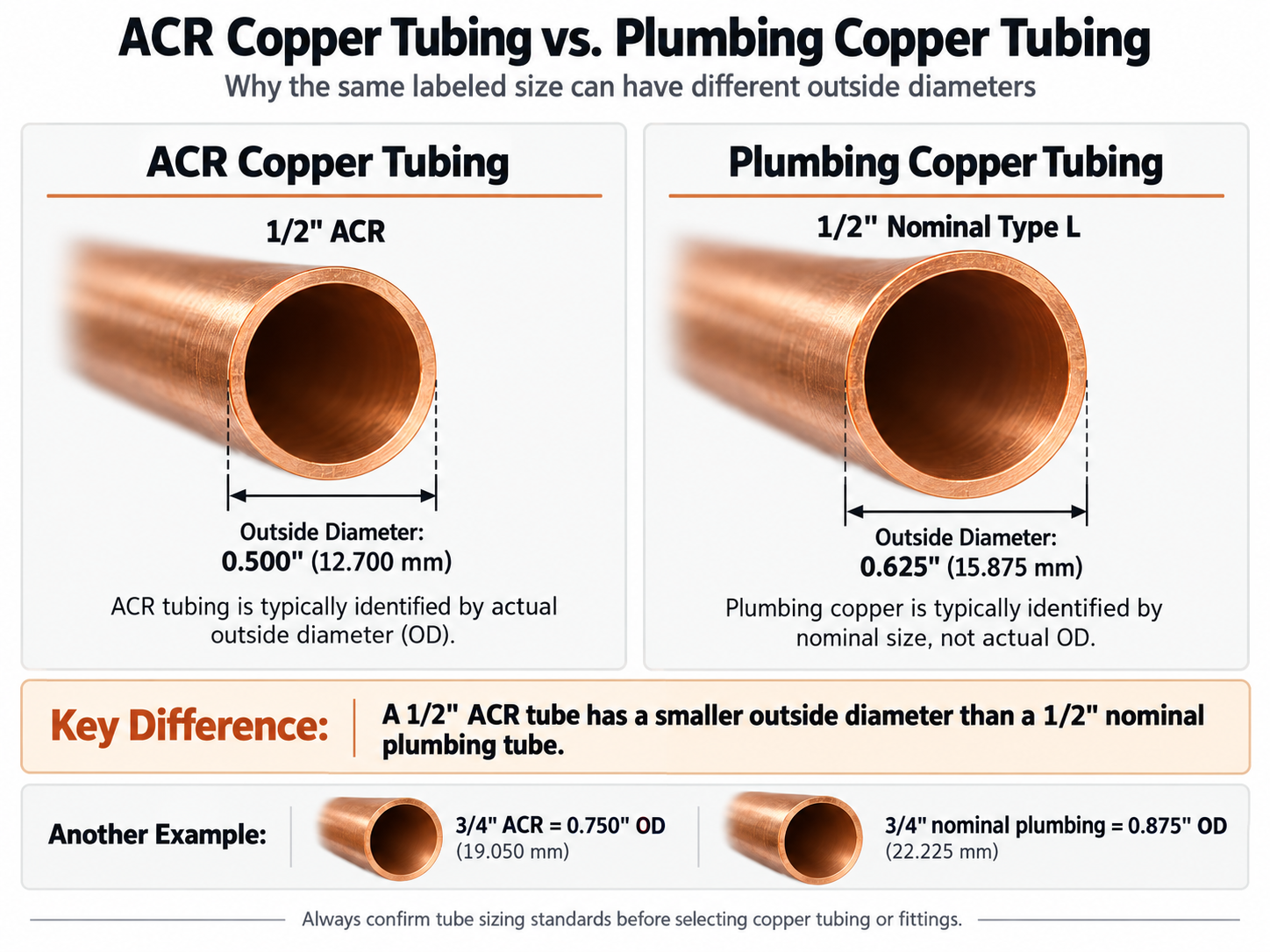
Although ACR copper tubing and plumbing copper tubing may look similar, they are not necessarily interchangeable.
One of the most common sources of confusion is the way these products are sized.
ACR Copper Tubing
ACR copper tubing is typically identified by its nominal outside diameter.
For example, a 1/2″ ACR copper tube has a nominal outside diameter of 0.500″.
Plumbing Copper Tubing
Common North American plumbing copper tubing conforming to ASTM B88 is typically identified using nominal sizes.
For example, a nominal 1/2″ Type L plumbing copper tube has an outside diameter of 0.625″, equivalent to 5/8″.
ACR vs. Plumbing Copper Tube Size Comparison
| Tube Description | Identified Size | Nominal Outside Diameter |
|---|---|---|
| ACR copper tubing | 1/2″ OD | 0.500″ (12.700 mm) |
| Type L plumbing copper tubing | 1/2″ nominal | 0.625″ (15.876 mm) |
| ACR copper tubing | 3/4″ OD | 0.750″ (19.050 mm) |
| Type L plumbing copper tubing | 3/4″ nominal | 0.875″ (22.225 mm) |
This distinction is especially important when ordering replacement copper tubing, selecting fittings, or reviewing installation specifications.
Can Plumbing Copper Tubing Be Used for Refrigeration
Copper tubing intended for plumbing should not automatically be substituted for ACR tubing.
Refrigeration applications have specific requirements concerning internal cleanliness, allowable pressure, material properties, and compatibility with refrigerants and refrigeration lubricants.
Any substitution must be evaluated against the system design and applicable standards.
How to Select the Correct ACR Copper Tube Size
Selecting the appropriate refrigerant tubing size involves more than matching the diameter of an existing connection.
The correct tube size depends on the refrigeration system’s design, operating conditions, and component requirements.
1. Identify the Refrigerant
Different refrigerants have different pressure and temperature characteristics.
For example, R744 (CO₂) refrigeration systems operate under substantially different conditions than many conventional HFC and HFO refrigeration systems.
For additional information on CO₂ operating pressures, see NDL Industries’ R744 CO₂ Pressure Temperature Chart and Refrigeration Guide.
Understanding refrigerant properties helps determine the appropriate tubing material, size, and pressure requirements.
2. Determine the Required Refrigerant Line Size
Refrigerant line sizing depends on factors such as system capacity, refrigerant mass flow, pressure drop, velocity, line length, and elevation changes.
Liquid, suction, and discharge lines may require different sizing considerations.
For example, an undersized refrigerant line can create excessive pressure drop, potentially affecting system performance and efficiency. An oversized line may create challenges with refrigerant velocity and oil return.
Refrigerant piping design should balance system capacity, refrigerant velocity, pressure drop, and oil return requirements to support efficient operation.
For additional technical guidance, explore the ASHRAE Handbook — Refrigeration, which covers refrigeration system design and related engineering considerations.
Always use the equipment manufacturer’s specifications and an appropriate engineering sizing method to determine the required line diameter.
3. Verify the Tubing Wall Thickness and Pressure Rating
Ensure the selected copper tubing meets the system’s design pressure and temperature requirements.
Do not assume that all copper tubing with the same outside diameter shares the same allowable working pressure.
4. Confirm Fitting Compatibility
Copper fittings must match the tubing’s required outside diameter, connection method, and application.
For example, tubing identified as 7/8″ OD must be paired with a fitting intended for the corresponding tubing size.
Additionally, confirm the fitting’s specified pressure rating, material compatibility, and joining requirements.
5. Follow Applicable Installation Requirements
Proper installation is essential to maintaining the reliability of the refrigeration system.
This includes using approved joining methods, following manufacturer instructions, protecting tubing from contamination, and performing the required pressure testing and commissioning procedures.
ACR Copper Fittings for HVAC-R Applications
Selecting the correct copper tubing is only one part of establishing a reliable refrigeration piping system.
The fittings connecting those tubes must also be suitable for the system’s pressure, temperature, refrigerant, and installation requirements.
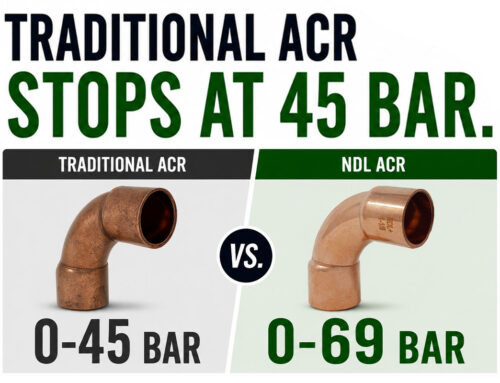
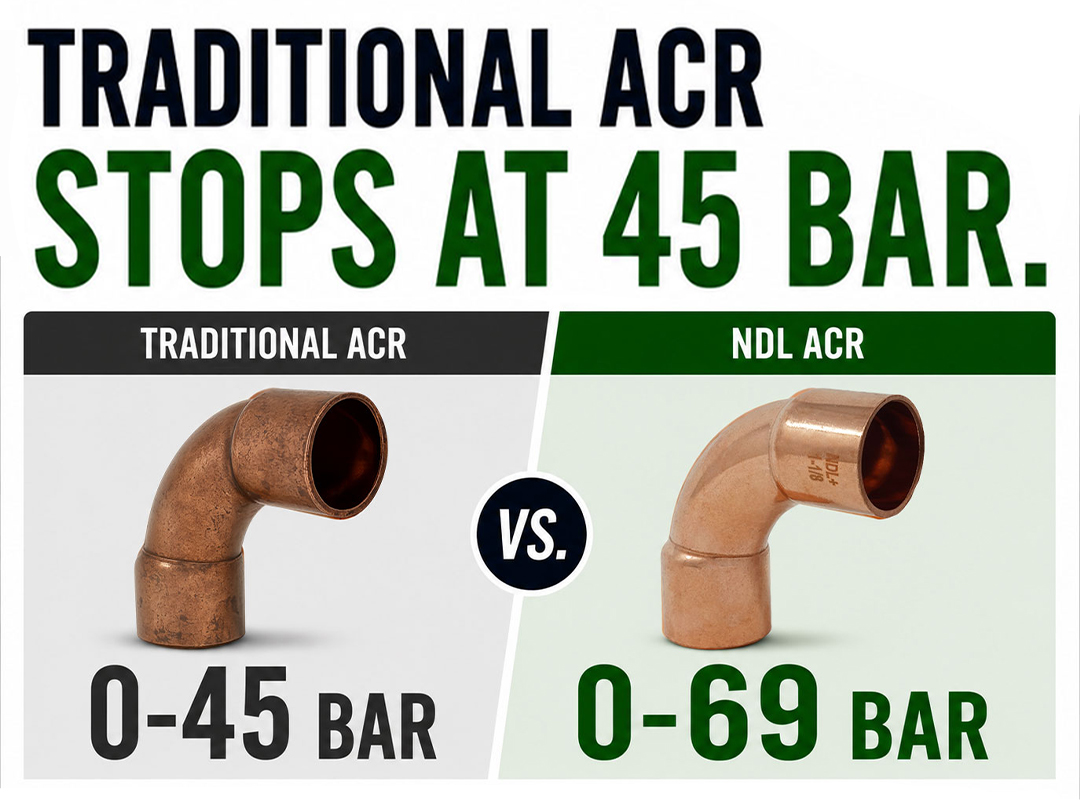
We manufacture ACR copper fittings for HVAC and refrigeration applications, with pressure ratings that vary by fitting size.
Our ACR copper fittings offer:
These fittings provide options for contractors and engineers working across a range of HVAC and refrigeration applications.
By confirming tubing dimensions and fitting compatibility during system design and installation, contractors and engineers can help reduce connection issues and ensure components meet their intended operating requirements.
Explore our ACR Copper Fittings to view our complete product selection, pressure ratings, technical specifications, and available sizes for HVAC and refrigeration applications.
Frequently Asked Questions About ACR Copper Tubing
What does ACR stand for in copper tubing?
ACR stands for Air Conditioning and Refrigeration. ACR copper tubing is designed for use in refrigerant piping systems and is commonly manufactured to requirements covering dimensions, cleanliness, and material properties.
Is ACR copper tubing measured by inside or outside diameter?
ACR copper tubing is typically identified by its outside diameter (OD). For example, 3/8″ ACR tubing has a nominal outside diameter of 0.375″, equivalent to 9.525 mm.
What is the outside diameter of 1/2″ ACR copper tubing?
The nominal outside diameter of 1/2″ ACR copper tubing is 0.500″, or 12.7 mm. This differs from nominal 1/2″ plumbing copper tubing, which typically has a 0.625″ outside diameter.
What is the outside diameter of 7/8″ ACR copper tubing?
A 7/8″ ACR copper tube has a nominal outside diameter of 0.875″, equivalent to 22.225 mm.
Is ACR copper tubing the same as Type L copper tubing?
Not exactly. ACR identifies tubing intended for air conditioning and refrigeration applications, while Type L refers to a plumbing copper tubing wall thickness designation. Some ACR tubing products have dimensions corresponding to Type L tubing, but their application requirements, cleanliness, and sizing conventions must also be considered.
What is the standard wall thickness of ACR copper tubing?
There is no universal wall thickness for all ACR copper tubing. Wall thickness varies by tube diameter, temper, product specification, and manufacturer. Consult the applicable tubing standard and technical dimensional tables for specific measurements.
Can ACR copper tubing be used for CO₂ refrigeration?
Copper tubing suitability for R744 (CO₂) refrigeration must be evaluated against the pressures, temperatures, materials, and applicable design standards of the specific system. Conventional ACR tubing should not be assumed suitable for high-pressure CO₂ applications without engineering verification.
How do I convert ACR copper tube sizes from inches to millimeters?
Multiply the outside diameter in inches by 25.4.
For example:
7/8″ = 0.875 × 25.4 = 22.225 mm.
This method can be used to convert any fractional inch outside diameter into its metric equivalent.